Who regulates medical device ads and videos? FDA, FTC and the new rules for AI
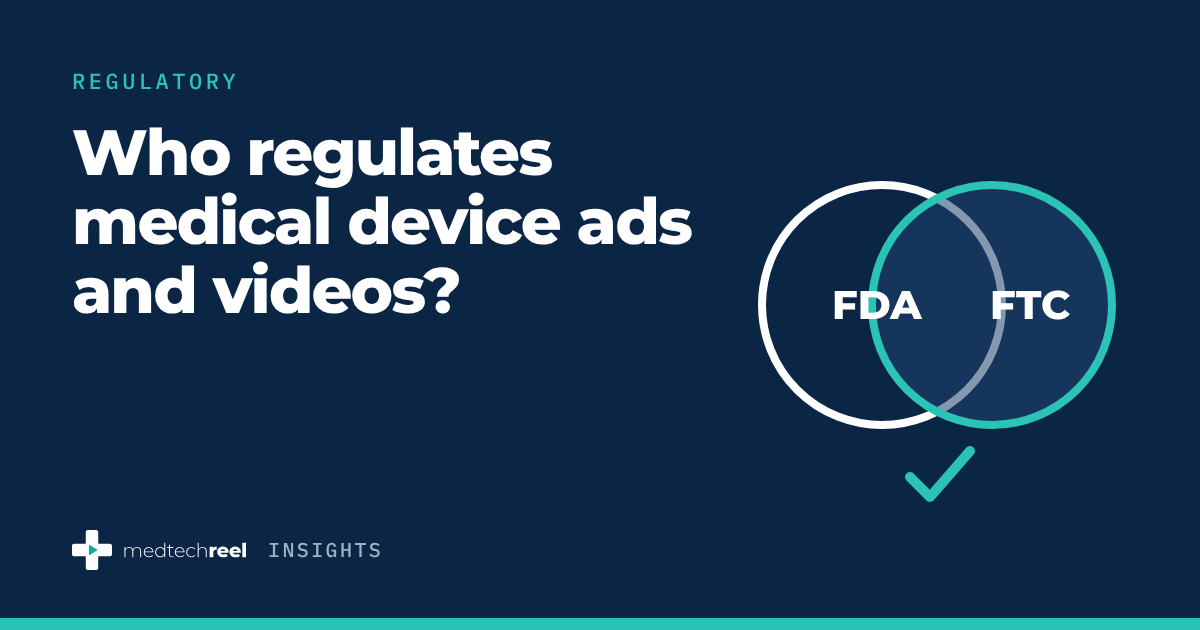
The FDA regulates labeling for all medical devices and advertising for restricted devices, which include many PMA-approved Class III products. The FTC regulates advertising for most other devices, including most 510(k)-cleared products. Whether a specific video is labeling or advertising depends on how it's used. Under the FTC's 2024 rule, AI-generated testimonials from people who don't exist or never used the product are banned.
Every medical device video eventually reaches the same question in review: which rules apply to this? The answer depends less on the video itself than on two facts about your product and one fact about how the video will be used. Get those three right before scripting, and most of the late-stage review surprises disappear.
This guide walks through who oversees device promotion in the US, how a single video can be treated as labeling in one channel and advertising in another, and what changed for AI-made content in 2024. It's written for marketing, training and product teams. Your regulatory and legal colleagues make the final call on any specific piece.
Two agencies, one split
Since a 1971 memorandum of understanding, the FDA and the Federal Trade Commission have divided device promotion between them. In practice the split looks like this:
| Agency | What it oversees | Core rules |
|---|---|---|
| FDA | Labeling for every device, and advertising for restricted devices | Labeling must not be "false or misleading in any particular" (FD&C Act §502(a)). For restricted devices, advertising must not be false or misleading (§502(q)) and must include the established name plus a brief statement of intended uses and relevant warnings, precautions, side effects and contraindications (§502(r)). |
| FTC | Advertising for devices that aren't restricted, which covers most 510(k)-cleared products | No unfair or deceptive practices (FTC Act §5) and no false advertising for devices (§12). Health claims need "competent and reliable scientific evidence" (FTC Health Products Compliance Guidance, December 2022). |
Neither agency reviews device videos before they run. The FTC says so explicitly, and there's no general FDA pre-clearance for device promotion. That makes your internal medical, legal and regulatory (MLR) review the real gate.
First fact: is your device "restricted"?
"Restricted device" is a legal status, not a description of risk. For many Class III devices it comes straight from the PMA approval order. FDA's approval letters typically say the sale and distribution of the device are restricted to prescription use under 21 CFR 801.109, that the device is further restricted under section 515(d)(1)(B)(ii) of the Act, and that it is "therefore a restricted device subject to the requirements in sections 502(q) and (r)." That language appears, for example, in the 2016 approval letter for PMA P150043.
Most 510(k)-cleared devices are not restricted in this sense, so their advertising falls to the FTC. Don't guess. Pull your clearance or approval order before you brief a video, and note the status at the top of the script.
If your device is restricted, a paid or broadcast video is advertising under FDA's §502(r). That means the established name and a brief statement of intended uses and key risks have to be part of the piece itself, not just a link in the caption.
Second fact: what is the device cleared or approved for?
Every claim in the video has to fit the cleared or approved indications. Under 21 CFR 801.4, FDA judges a device's intended use by the "objective intent" of the people responsible for its labeling, and that intent "may, for example, be shown by labeling claims, advertising matter, or oral or written statements." A surgeon's off-the-cuff remark in a testimonial, a voiceover line written for punch, or an on-screen animation that implies a broader use can all become evidence of an intended use you don't have clearance for.
The practical fix is boring and effective: build the script as a table where every line maps to a sentence in the IFU, the indications for use statement, or an approved claims matrix entry. If a line can't be mapped, it doesn't go in the video. We walk through that table, and the review packet around it, in our MLR review guide.
Third fact: will the video be used as labeling or as advertising?
The FD&C Act defines labeling as written, printed or graphic matter on the device or "accompanying such article" (21 U.S.C. §321(m)). Courts have long read "accompanying" broadly. Material doesn't have to ship in the same box to count. In practice, the same edit can be treated differently depending on where it ends up:
Materials that explain or supplement the device
- Training modules for reps, distributors and clinical specialists
- Procedure or set-up videos shared with customers
- Videos hosted on a product page as part of the device information
Media placed to drive interest or sales
- Paid social, pre-roll and connected-TV spots
- Booth loops and conference sponsorship reels
- Sponsored content in trade publications
Two consequences follow. A video that starts life as internal training and later gets cut into a social ad needs a fresh review for its new use. And a "harmless" brand video still has to be consistent with your labeling, because FDA can treat promotional material as evidence of intended use whichever agency polices the advertising.
Rules that apply either way
- Stay on label. No indications, patient populations, or performance claims beyond what's cleared or approved.
- Substantiate every objective claim. FDA expects claims to be backed by valid scientific evidence; the FTC applies its competent-and-reliable standard and generally expects well-controlled studies for health benefit claims.
- Disclose limitations clearly and conspicuously. The FTC's guidance says a claim made both visually and in the audio should carry its qualifier both ways. A fast lower-third under a confident voiceover doesn't do it.
- Be careful with comparisons. Head-to-head claims generally need head-to-head data. Comparing published specifications can be defensible only when the test methods match and nothing implies a clinical advantage.
- Treat testimonials as claims. A clinician or patient describing results is read as typical unless you can support that or disclose what to expect.
Where AI changes the picture
Most AI in device video is uncontroversial: a synthetic narrator voice, faster motion graphics, translated captions. The risk concentrates in two places.
Synthetic people giving testimony. The FTC's rule on consumer reviews and testimonials (16 CFR Part 465, effective October 21, 2024) bans fake reviews and testimonials, including AI-generated ones and those attributed to people who don't exist or never used the product. Civil penalties can reach $51,744 per violation. An AI-generated "surgeon" praising your device is exactly the pattern the rule targets. Use real clinicians with signed agreements, or clearly labeled dramatizations with real actors.
Generated visuals of the device in use. An image model can draw a device doing something it isn't cleared to do, in an anatomy it isn't indicated for, in a single frame nobody notices until review. Build visuals from your CAD, product photography, or approved illustrations, and treat every generated frame as a claim that needs checking.
We tell clients exactly which elements are AI-generated, never synthesize a clinician or patient, and get signed releases for any real voice or likeness. It keeps the review conversation about the content, not about how it was made.
A pre-production checklist
- Confirm regulatory status510(k), De Novo or PMA, and whether the order makes the device restricted.
- Name the channelsTraining, product page, paid media, booth. Each one decides whether you're writing labeling or advertising.
- Build the claims tableEvery script line mapped to the IFU, indications statement or claims matrix, with revision numbers.
- Place the risk informationFor restricted-device advertising, write the brief statement into the piece. For everything else, plan qualifiers that appear on screen and in the audio.
- Log the AI and the peopleList generated elements, releases for every voice and likeness, and any dramatization labels.
- Archive what was approvedKeep the approved master, the claims table and where it ran, so a later cut-down starts from a reviewed version.
This article is general information for marketing and training teams, not legal or regulatory advice. Your regulatory affairs and legal teams decide how these rules apply to a specific product.
Video summary
Read the on-screen text
Which rules apply to your device video? Three facts decide it. 1. Is the device restricted? Many PMA approval orders say so. Restricted means FDA oversees its advertising. 2. What is it cleared for? Every line must fit the indications. Ads are evidence of intended use. 3. Labeling or advertising? Training and product pages act like labeling. Paid media is advertising. 4. No synthetic testimonials. The FTC's 2024 rule bans fake and AI-generated reviews and testimonials. Read the full guide: medtechreel.com/insights
FAQ
Does the FDA have to approve a medical device ad before it runs?
No. There is no general requirement to submit device promotional videos to FDA before use, and the FTC does not review ads in advance either. Companies rely on internal medical, legal and regulatory review, and both agencies can act after the fact.
How do I know if my device is a restricted device?
Check your clearance or approval order. Many PMA approval orders restrict sale to prescription use and state that the device is a restricted device subject to sections 502(q) and (r) of the FD&C Act. Most 510(k)-cleared devices are not restricted in this sense.
Can we use an AI-generated doctor or patient in a device video?
Not as a testimonial. The FTC's rule on reviews and testimonials, effective October 21, 2024, prohibits fake testimonials, including AI-generated ones and those attributed to people who don't exist or never used the product. Use real clinicians with agreements, or labeled dramatizations with real actors.
Is a training video for sales reps considered labeling?
Often, yes. Material that explains or supplements the device and is distributed by the manufacturer is generally treated as labeling, so it must be consistent with the cleared or approved indications and not false or misleading. Your regulatory team makes the final call.
Sources
- 21 U.S.C. §352: misbranded drugs and devices, including (a), (q) and (r) (Cornell LII)
- 21 U.S.C. §321(m): definition of labeling (Cornell LII)
- 21 CFR 801.4: meaning of intended uses (Cornell LII)
- FDA PMA approval letter P150043 (2016), restricted device language
- RAPS: Promotion of FDA-Regulated Medical Products, FDA-FTC memorandum of understanding
- Covington: FTC issues Health Products Compliance Guidance (Jan 2023)
- Goodwin: FTC finalizes rule on consumer reviews and testimonials (Sept 2024)
- FDLI: Advertising and Promotion of Medical Devices (2022 presentation)
Need a video built this way?
Fixed prices from $2,500, first cuts in about a week, scripts traced to your approved labeling.
Book a 20-minute callKeep reading
How to get a medical device video through MLR review in fewer rounds
Why videos take more medical, legal and regulatory review rounds than print, and a four-gate method, script table and reviewer packet that cut them down.
Oct 25, 2026 · 8 min read
How much does a medical device training video cost in 2026?
2026 price ranges for medical device training, explainer and animation videos, what drives the cost in regulated companies, and how to budget a training program.
Oct 24, 2026 · 8 min read