EU MDR language requirements for medical device videos
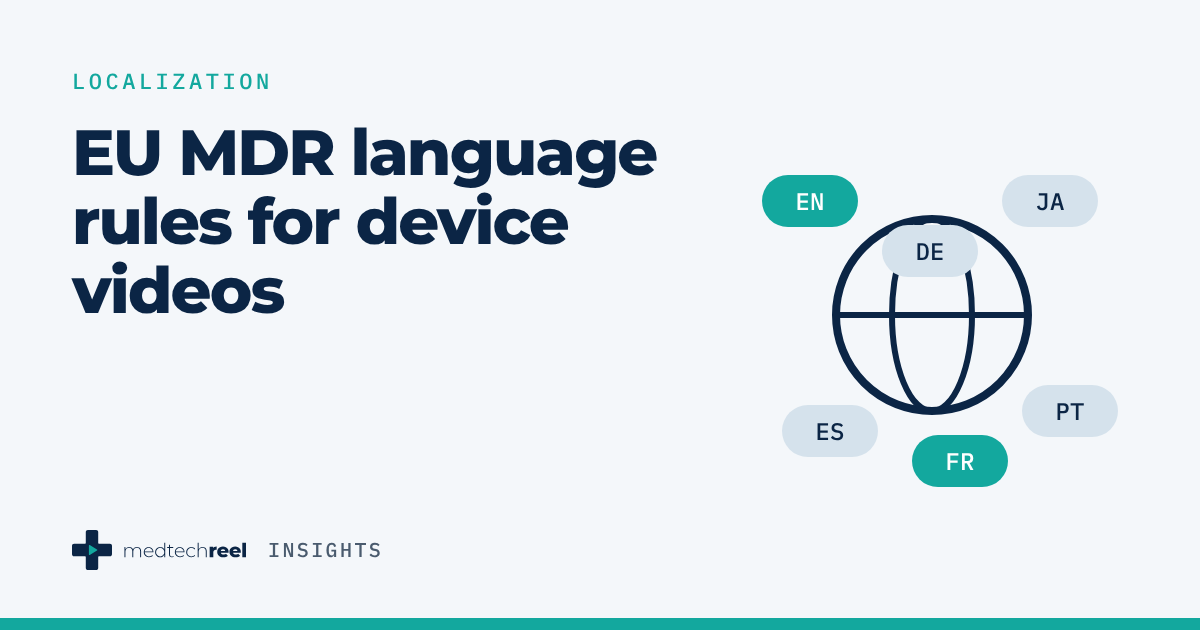
Under EU MDR Article 10(11), the label and instructions for use must be in the official language or languages set by each Member State where the device is sold, so a video that forms part of the IFU follows those rules. Many countries accept English for professional users but not for lay users; the European Commission's language table lists each country. Promotional videos are driven by Article 7, which bans misleading claims in every language version. Internal training usually has no MDR language rule unless it doubles as use instructions.
A US device company preparing for its first EU launch usually has a folder of English videos: a procedure animation, a setup tutorial, a booth loop, a few sales training modules. Someone asks which ones need to be translated, and for which countries. The answer is rarely "all of them, into everything," and it is rarely "none."
The EU Medical Device Regulation (MDR) does not have a chapter on video. It has rules for the information that accompanies a device, rules for claims, and a separate implementing regulation for electronic instructions for use. Each Member State then sets the languages. This guide shows how those pieces apply to the videos a device company actually makes, with a worked example and a checklist you can use on your own library this week.
Start by sorting each video into one of four buckets
The MDR language rule is attached to a specific set of information, not to a format. Article 10(11) requires manufacturers to ensure the device is accompanied by the information in Section 23 of Annex I "in an official Union language(s) determined by the Member State in which the device is made available." Section 23 covers the label and the instructions for use (IFU). The MDR defines the IFU as the information the manufacturer provides to inform the user of a device's intended purpose and proper use and of any precautions to be taken.
So the first question for any video is not "is it a video?" It is "what job does it do?" We sort every video in a library into one of these four buckets before anyone gets a translation quote.
| Bucket | Typical videos | What drives the language |
|---|---|---|
| Part of the IFU or other information supplied | A setup or use video that the IFU points to, or that replaces steps in it | MDR Art. 10(11) and each Member State's language rule for label and IFU |
| Inside the device or its software | On-screen tutorials in an app or console | National rules for the user interface, where a country has them |
| Promotional | Launch, booth and website videos | MDR Art. 7 on claims, plus national advertising and language law |
| Internal or distributor training | Sales rep and distributor modules | Usually your own training and quality procedures, unless the content doubles as use instructions |
The fourth bucket is where teams get surprised. A sales training module that walks through device setup step by step may end up being handed to hospital staff. Once it is used to teach proper use, your regulatory team may treat it as information supplied, and the language rules follow. Decide the bucket in writing, and keep the video's distribution consistent with that decision.
How the Member State language rules apply
The MDR leaves the choice of language to each country. To help manufacturers, the European Commission publishes an overview table of national language requirements under the MDR. The current version is Revision 3, dated August 2025. It splits each requirement into patient or lay users and professional users, and it covers the label and IFU, the implant card, the declaration of conformity, field safety notices, documents for conformity assessment and graphic user interfaces.
Here is the label and IFU column for a handful of countries, as the table states it.
| Country | Lay users | Professional users |
|---|---|---|
| Germany | German | German or English, or the users' language in justified cases |
| France | French | French |
| Spain | Spanish | Spanish |
| Italy* | Italian | Italian |
| Netherlands | Dutch | Dutch or English |
| Belgium | French, Dutch and German | French, Dutch, German or English |
| Denmark | Danish | Danish, English possible on request |
*The table marks Italy as a country where recent information is not available.
Two practical points come out of that table. First, the professional-user column is often more flexible than the lay-user column. A video for surgeons in the Netherlands may be acceptable in English. The same video for patients is not. Second, Belgium is three languages for lay users, not one, which changes the subtitle plan for any patient-facing video sold there.
The table itself says the Commission services do not take responsibility for the correctness of its information, and that the MDR and the Member States' own provisions take precedence. Use it to scope the work, then have your regulatory team or local distributor confirm the national text for each launch country.
Electronic IFU: where video usually lives
Most use videos are delivered online, so the electronic IFU rules matter. Annex I, Section 23.1(f) allows instructions for use in a non-paper format only to the extent, and under the conditions, set by separate EU rules. The regulation named there, (EU) No 207/2012, has since been repealed by Commission Implementing Regulation (EU) 2021/2226, which was itself amended in 2025.
In the consolidated text, three provisions shape a video plan:
- Electronic IFU is allowed for devices intended for use by professional users. If lay use is reasonably foreseeable, the instructions intended for lay persons must be provided on paper.
- The electronic IFU must be available in all Member States where the device is made available, unless the risk assessment duly justifies otherwise. On the manufacturer's website, it must be in an official language of the Union determined by the Member State.
- Users can request a paper IFU at no additional cost, delivered within the period set in the risk assessment and at the latest within 7 calendar days.
The last point is easy to forget when a video carries real instructional content. A video cannot be printed. If your video shows a step or a warning that the written IFU does not, a user who asks for paper is missing something. Our rule of thumb: the written IFU stays complete on its own, and the video demonstrates it. That keeps the video a supplement and keeps translation scope predictable. Our post on turning an IFU into a training video walks through how to build a video that tracks the IFU line by line.
Promotional videos: Article 7 applies in every language
For launch, booth and website videos, the language rules above usually aren't the deciding factor. Claims are. MDR Article 7 prohibits text, names, trademarks, pictures and other signs that could mislead the user or patient about a device's intended purpose, safety and performance. It applies to labeling, the IFU, making the device available, putting it into service and advertising.
Article 7 gives four examples of what counts as misleading: ascribing functions or properties the device does not have; creating a false impression about treatment, diagnosis or the device's functions; failing to inform about a likely risk of using the device as intended; and suggesting uses other than the intended purpose assessed in conformity assessment.
Translation is where the fourth example sneaks in. A translator who doesn't know the approved intended purpose will pick the natural word, and the natural word can be broader. "Indicated for adults" becomes "for patients." A specific vessel becomes "blood vessels." Each change is small, and each one can widen the claim. National advertising and language laws can also apply to promotional material, so check with your local affiliate or distributor before a campaign runs. For the US side of the same question, see our guide to who regulates medical device advertising.
A worked example: one library, three countries
Fictional example. Harbor Point Surgical (a fictional company) is launching a Class IIb surgical stapling system in Germany, the Netherlands and Belgium. It is used only by trained surgical staff. The video library has five pieces. Here is how its team scopes them.
| Video | Bucket | Language plan |
|---|---|---|
| Loading and firing tutorial, linked from the IFU | Information supplied, professional users | The table permits English for professionals in all three countries. The team still records German and Dutch captions because staff ask for them, and confirms with regulatory that the English version meets each national rule. |
| Cleaning and reprocessing video | Information supplied, professional users | Same as above. Every warning in the video already appears in the written IFU. |
| Launch video for the website | Promotional | German, Dutch and French versions. Each translated script goes back through claims review against the intended purpose. |
| Booth loop for a European congress | Promotional | No narration. On-screen text in English with a translated version for local regional events. |
| Distributor sales training | Internal training | English, with a written instruction that it is not shown to hospital staff. |
Notice what is not on the list: a patient video. If Harbor Point later adds one, the lay-user column applies, so Belgium alone would need French, Dutch and German.
A quick US footnote for Spanish-language versions
US teams sometimes plan a Spanish version of a labeling video at the same time as EU work. FDA's rule in 21 CFR 801.15(c) generally requires required label and labeling information in English, with an exception for articles sold only in Puerto Rico or a US territory where another language predominates. It also says that if a label contains any representation in a foreign language, the required information must appear in that language too, and the same applies to labeling. A Spanish voiceover that drops a warning the English version carries is a problem. Translate the whole required content, or don't translate.
A checklist before you request translation quotes
- List every video and its bucketInformation supplied, user interface, promotional or internal. Get regulatory sign-off on the list.
- Map buckets to countries and usersFor each launch country, note whether the audience is lay or professional and pull the label and IFU language from the Commission table.
- Confirm the national textAsk regulatory or the local distributor to confirm each country's rule. The table is a guide, not the law.
- Lock the English firstFinish claims review in English before translation. Every change after translation multiplies.
- Give translators the intended purposeSend the approved intended purpose and a short glossary with the script so wording doesn't drift broader.
- Review each language for claimsA bilingual reviewer checks each translated script against the intended purpose before any voice is recorded.
- Keep the written IFU completeNothing safety-relevant should live only in the video.
Captions are usually the cheapest way to cover several languages for professional-use content, and recorded narration is worth it where the audience is lay or the setting is noisy. Our medical video localization work starts from exactly this kind of inventory.
General information about EU and US rules as of the date of this post, not legal or regulatory advice. Language requirements depend on the device, its users and each country's law, so confirm the plan with your regulatory team.
Video summary
Read the transcript
Which of your device videos need translating for the EU? Start with what each video does. Sort each video by its job. A video that is part of the IFU follows each country's IFU language rule. Lay users or professionals. Some countries accept English for professionals. Patients get their language. Check the Commission table. It lists label and IFU languages by country. National law still wins. Claims rules travel too. MDR Article 7 bans misleading claims in every language version. To recap. Sort each video by its job. Lay users or professionals. Check the Commission table. Claims rules travel too. Read the full guide at medtechreel.com/insights.
FAQ
Does the EU MDR require videos to be translated?
Not as a category. Article 10(11) applies to the label and instructions for use, so a video that is part of the IFU follows each Member State's language rule. Promotional and internal videos are governed by other rules.
Can instructions for use be in English in the EU?
For professional users, some countries accept English, including Germany, the Netherlands and Belgium according to the European Commission's language table. For lay users, the national language is generally required. Confirm the national text for each country.
Can a device's instructions for use be provided only online in the EU?
Under Implementing Regulation (EU) 2021/2226, electronic IFU is allowed for devices intended for professional users. Instructions for lay persons go on paper where lay use is reasonably foreseeable, and users can ask for paper within 7 calendar days at no extra cost.
Do translated marketing videos need another review?
Yes. MDR Article 7 bans claims that mislead about intended purpose, safety or performance, including suggesting uses beyond the intended purpose. Have each translated script checked against the approved intended purpose.
Sources
- Regulation (EU) 2017/745 (MDR), Chapter II including Article 10(11), 10(14) and 18(1) (legislation.gov.uk, as adopted)
- MDR Article 7: Claims (legislation.gov.uk, as adopted)
- MDR Article 2: definitions of label and instructions for use (legislation.gov.uk)
- MDR Annex I, Section 23: information supplied with the device (legislation.gov.uk, as adopted)
- European Commission: Overview of language requirements for manufacturers of medical devices
- European Commission: MDR language requirements table, Rev. 3 (August 2025)
- Commission Implementing Regulation (EU) 2021/2226 on electronic instructions for use, consolidated 16 July 2025 (EUR-Lex)
- 21 CFR 801.15: medical device labeling, prominence and language (Cornell LII)
Need a video built this way?
See it first: a $500 preview cut of your video, credited in full if you go ahead. Fixed quotes from $1,600, scripts traced to your approved labeling.
Start with a $500 previewKeep reading
Booth videos for 510(k)-pending and investigational devices
You can display a 510(k)-pending device at a trade show but not take orders. What FDA policy allows in a booth video, the caution rule, and a script checklist.
Oct 27, 2026 · 8 min read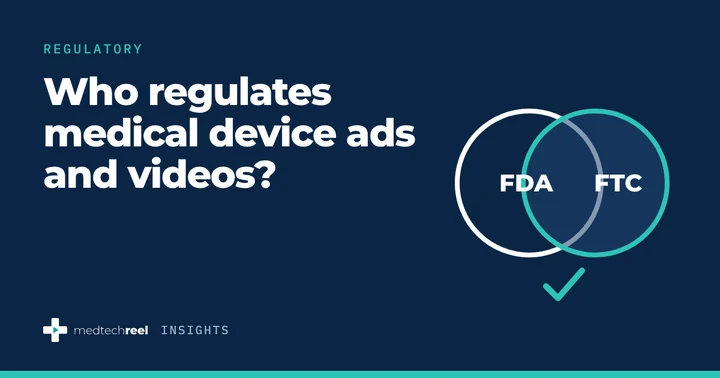
Who regulates medical device ads and videos? FDA, FTC and the new rules for AI
FDA oversees device labeling and restricted-device advertising; the FTC polices most other device ads. What that means for your next product or training video, plus the 2024 rule on AI-generated testimonials.
Oct 25, 2026 · 8 min read